
GEO Hub
External GEO intelligence: industry news, vendor moves and market digests, summarised for operators.
All articles
53 published in GEO Hub.

The AI Contribution Pilot: What Pay-Per-Value Licensing Means for Content Strategy
The search giant is quietly testing a program that pays publishers when their content shapes AI responses — not just when it's linked. Here's what the early signals mean for GEO practitioners.

AI Search Summaries Cut Wikipedia Traffic by 5%
A University of Washington study found AI Overviews reduced English Wikipedia search traffic by 5%, costing an estimated 1.2 billion yearly visits — and the decline is accelerating.

The llms.txt Standard Is Failing Its Own Specification
Common Crawl's analysis of 584K llms.txt files reveals widespread misuse: 68% are plugin-generated, 23% have zero links, and major AI services ignore the format entirely.

Europe's Search Redesign Splits Aggregators and Suppliers
The DMA's €890 million fine forces a structural split in European search results between comparison services and direct suppliers — and real-time pricing is gone.

What Is Schema Markup
Schema markup explicitly labels content entities for AI engines. Learn key types and how they differ from structured data.

GEO for Kitchenware
Optimize kitchenware content for AI extraction with food-grade certifications, material specs, and compliance data.

What Is Semantic Search
Semantic search matches meaning, not keywords. Learn how it changes B2B content strategy and entity matching.

What Is the Difference Between SEO and GEO
SEO targets rankings; GEO targets AI answer visibility. Learn differences, overlaps, and unified strategy.

What Is Retrieval-Augmented Generation (RAG)
RAG determines which content AI engines retrieve for answers. Learn how it works and why it matters for GEO.

What Is AI Search Visibility
AI search visibility combines mention rate and citation rate. Learn how to measure it and why traditional metrics fall short.

GEO for CNC Equipment
Optimize CNC equipment content for AI extraction with precision specs, application pages, and comparison tables.

GEO for Mobile Accessories
Optimize mobile accessory content for AI extraction with compatibility tables, MFi certification, and charging protocol data.

GEO for Consumer Electronics Manufacturing
Optimize consumer electronics manufacturing content for AI extraction with BOM data, process flows, and compliance pages.

GEO for Fashion Accessories
Optimize fashion accessory content for AI extraction with material specs, certification data, and trend pages.
What Is Structured Data for AI
Structured data helps AI engines identify and cite your content accurately. Learn key schema types and implementation guidance.
What Is Extractability
Extractability determines how easily AI engines can parse and reuse your content. Learn the key factors and common barriers.

What Is Citation Rate
Citation rate measures how often AI engines credit your domain as a source. Learn what drives citations and how it differs from mention rate.
What Is Mention Rate
The percentage of AI answers that name a specific entity. Understand the formula and key drivers.
What Is Generative Engine Optimization (GEO)
GEO is the practice of optimizing content for AI answer engines. Learn how it differs from traditional SEO and why it matters for B2B visibility.

GEO for Furniture
Optimize furniture content for AI engines with text specifications, style guides, and compliance data.

GEO for Industrial Machinery
Optimize industrial machinery content for AI engines with technical parameters, case studies, and comparison tables.
GEO for Electronic Components
Optimize electronic component pages for AI extraction with specification tables, cross-references, and compliance data.
GEO for Textile Fabrics
Optimize textile fabric content for AI extraction with specification tables, sustainability credentials, and glossary pages.
GEO for Apparel Sourcing
Optimize apparel sourcing content for AI answer engines. Strategies for specifications, certifications, and process descriptions.

AI Mode Shopping Picks Different Products at Higher Prices
AI Mode and the standard shopping carousel share just 1.28% of products — and when items do overlap, AI Mode shows pricier options 68% of the time. Here's why and what it means.

How Product Feeds Reshaped ChatGPT Shopping Visibility
ChatGPT's shift from web crawling to product feeds has reshuffled merchant visibility — top 10 stores nearly doubled their share. Here's what changed and what it means for B2B suppliers.
GEO for LED Lighting
How LED manufacturers can optimize luminous efficacy and spec tables for AI citation in procurement queries.
GEO for Auto Parts and Accessories
How auto parts sellers can structure fitment databases and certification data for AI answer extraction.

GEO for Cosmetics and Skincare
How beauty brands can structure ingredient, claim, and certification content for AI answer visibility.

What Is Vector Search
Vector search matches content by meaning rather than exact terms, powering AI retrieval.

Homepage AI Shortcuts: From Search Gateway to AI Tool Platform
Three new AI buttons on the world's most-visited homepage — "Create images," "Ask about files," "Brainstorm" — replace classic submit controls, signaling a fundamental redesign of the search gateway model.

AI Overviews Local Search Quality: Listicles Replace Authority Sources
Search Engine Roundtable documented AI Overviews citing promotional listicles over authoritative local businesses. theStacc found 88% of local markets lost visibility.

AI Overviews Impact on Organic Search CTR: Updated Analysis
Ahrefs updated their widely cited study and found AI Overviews now reduce top-rank CTR by 58% — nearly doubling from 34.5%. Pew, SparkToro, and Dataslayer data converge on the same conclusion.
GEO for Packaging Machinery
Packaging machinery GEO: integration parameters across mechanical, electrical, and protocol layers have no industry-standard publication format.

Anthropic Commerce Agent Blueprints: Open-Source AI Framework for Retail
Anthropic released Apache 2.0-licensed commerce agent blueprints for Claude on September 2, targeting retail, travel, telecom, and ticketing with open-source shopping and merchant AI assistants.

AI Max Migration Live: September Auto-Upgrade and DSA Delayed to 2027
The September 1 auto-upgrade applied AI Max to all eligible Search campaigns, affecting three traffic channels: traditional SERP, AI Overviews, and AI Mode. DSA migration was pushed to February 2027.

ChatGPT Product Feeds: Shopping Visibility and Ads Manager
OpenAI September 4 update made product feeds mandatory for shopping visibility, launched the Ads Manager Plugin, and expanded to 30+ new markets. Feed submission is free; paid campaigns start at $25/day.

Microsoft AI Max for Search: Global Launch and Performance Data
Microsoft AI Max for Search launched worldwide on August 27, bringing AI-native capabilities to Bing and Copilot. With engagement doubling and conversions up 13.6%, the paid search landscape is shifting fast.

Product Pages Capture 24% of AI Citations: What 7,387 URL Mentions Reveal About Source Preference
A new study across four AI search engines shows product pages dominate citations while Reddit and YouTube barely register. Here is what the data means for GEO strategy.

Conversational Search Goes Default: The End of the Expansion Button
AI Mode's conversational capabilities are merging directly into AI Overviews — and the click-through era is shrinking faster than anyone expected.

Search Clicks Now Route Through a Redirect Wall — Implications for GEO Monitoring
The world's largest search engine is replacing standard hyperlinks with encrypted redirects, fundamentally altering how monitoring tools extract citation data from search results.
GEO for B2B Marketplaces: A Field-Tested Operating Model
A complete GEO operating model for B2B marketplaces: from prompt monitoring to content matrix to social media to external link building.
Infrastructure vs Campaign: The Two-Tier GEO Investment Model
Some platforms are infrastructure that must be held long-term. Others are campaign assets that can be deployed on demand. GEO portfolios need both tiers.

Global Plus Local: The Dual Structure of AI Citations
AI citation results show a dual structure: global high-influence sites and national high-frequency sites. GEO strategy must address both layers.

Semrush Analyzed 126 Million AI Prompts — Only 36 Brands Dominated Across All Platforms
The 2026 AI Visibility Index reveals massive disparities in how AI platforms cite brands. With ChatGPT citing 15 sources per response and Gemini just 3, GEO strategies must adapt to each platform's unique citation logic.

68% of Searches Now End Without a Click: What the 2026 Zero-Click Data Means for Brand Visibility
A SparkToro and Similarweb study reveals a historic 68% zero-click rate, with AI Overviews suppressing 60% of external visits. Here is what B2B brands and GEO practitioners need to know.

The Search Giant's August 2026 Quality Update Has a Clear Message: AI Mass-Produced Content Is the New Doorway Page
The August 2026 quality update sent shockwaves through search rankings, specifically targeting mass-produced AI content. With 14 independent monitoring platforms confirming sustained volatility, GEO practitioners must rethink content production strategies to avoid being flagged as synthetic search manipulation.
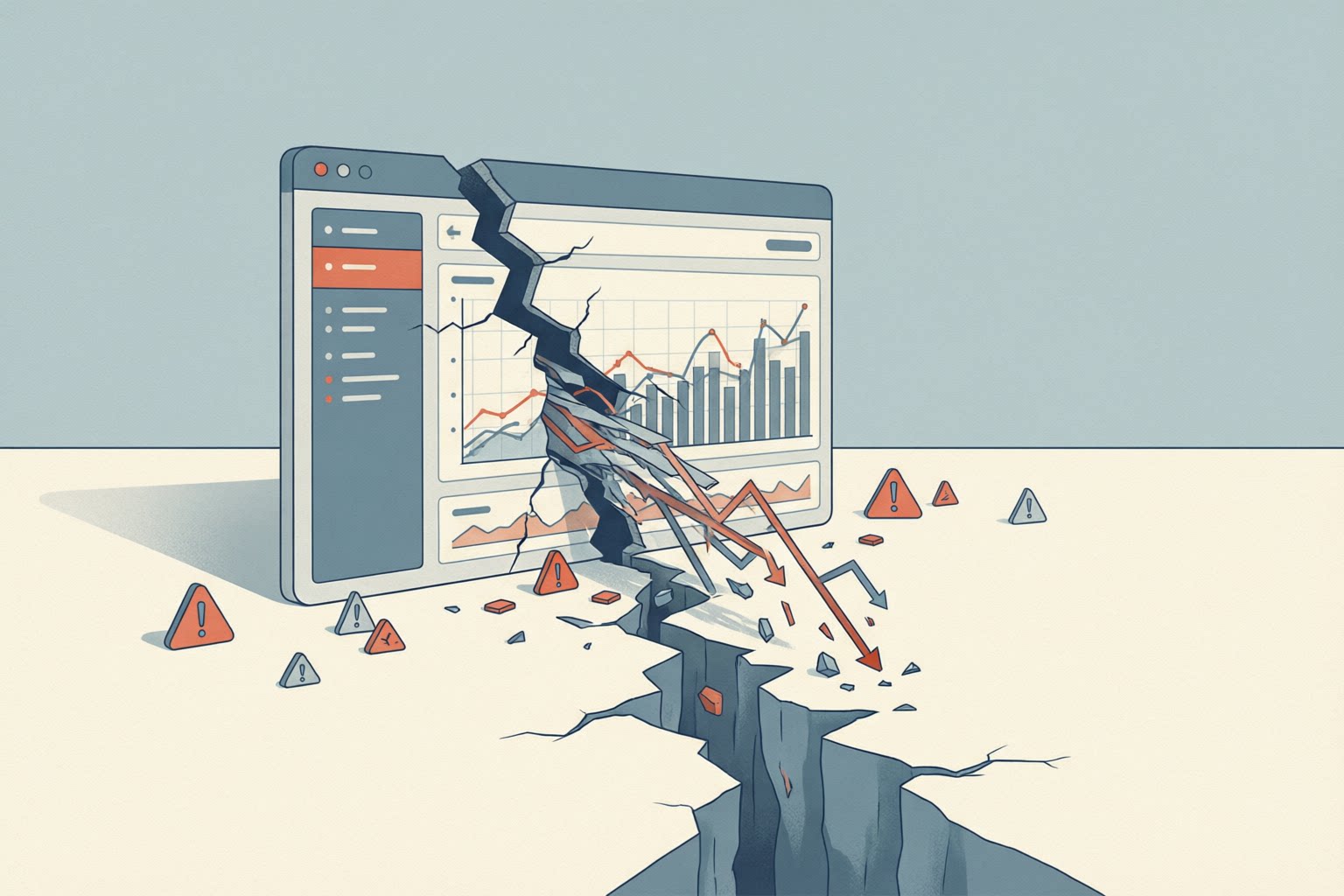
Search Console AI Report Breaks for Eight Days: What GEO Practitioners Should Do When the Only Measurement Tool Fails
The Generative AI performance report — the only official data source for measuring AI search visibility — suffered a logging bug from August 13 to 20, 2026. Combined with the concurrent quality update, practitioners faced a perfect storm of measurement uncertainty.

Preferred Sources Hits 600,000 Collections: Personalization as the New GEO Signal
The search giant's user-controlled personalization feature now spans Top Stories, Discover, AI Overviews, and AI Mode — with over 600,000 sources favorited. We analyze the growth data, the mechanics, and what it means for GEO visibility.

Generative UI Enters AI Overviews: When Search Builds the Tool Instead of Linking to It
Google's Generative UI now creates interactive tools — calculators, converters, planners — directly inside AI Overviews, reaching roughly 40% of queries. We analyze the rollout, the data, and what it means for GEO strategy.

Google's August 2026 Algorithm Update: Ranking Shifts Across 20 Industries and What It Means for AI Search
An in-depth analysis of the August 2026 algorithm changes and their impact on search visibility across 20 industries.

Reddit Citations in ChatGPT Collapsed 86% in Four Days — But the Model Still Reads It
Promptwatch data shows Reddit's ChatGPT citation share fell from 3.83% to 0.52% between August 14 and 17, while site-specific background searches jumped 46x. Multiple independent observers confirm the anomaly.
Search Console Opens Generative AI Impressions: Pages, Countries, Devices, Days
Google’s Generative AI report left grey release and is fully visible for UK Search Console properties as of 11 August 2026 — impressions by pages, countries, devices and days, still without clicks or queries.
Field-tested playbooks from the Alibaba.com GEO team — verified in practice, and ready for you to reuse.